The Club logo - LB&SCR Class D1 No. 27 'Uckfield' now available in model form
Exclusive 00 Model
from Uckfield MRC
LB&SCR Stroudley
Class D1 0-4-2T
No.27 Uckfield
Available to pre-order now from our web store
Delivery expected late 2027
In conjunction with Rapido Trains UK, the Uckfield Model Railway Club has commisioned an
exclusive 00 model of our Club logo - the London Brighton and South Coast Railway (LB&SCR) Stroudley Class
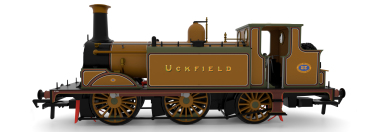
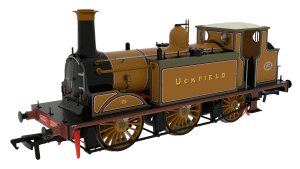
D1 0-4-2T Locomotive No. 27 'Uckfield' in Improved Engine Green livery as built in 1876.
You can look forward to a smooth-running mechanism, enhanced with a MoPower stay-alive capacitor,
all-wheel pickups, and powered rear wheels. Other features include a factory-installed speaker, front and rear NEM 362
coupler pockets, sprung buffers, a Next 18 DCC decoder socket, and firebox flicker with a dynamic fire draw effect on
DCC-fitted models.
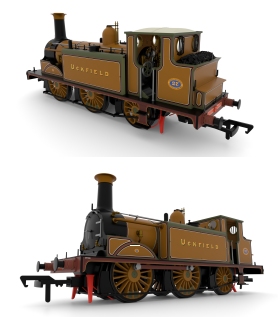
• LB&SCR Improved Engine Green
• Stroudley boiler and chimney
• Flush-riveted smokebox
• Condensing gear
• Original smokebox door
• Original dome with salter safety valves
• Firebox-mounted whistle
• Control arm-type handrail
• Stroudley clack valves
• Wooden brake blocks
• Internally mounted sandpipes
• Early Westinghouse pump
• Plain bufferbeam
• Next18 DCC decoder socket
• All-wheel drive including trailing axle
• MoPower stay-alive
• Diecast metal and plastic construction
• NEM 362 coupler pockets front and rear
• DCC Ready and DCC Sound versions
• 1:76 4mm/ft scale 16.5mm gauge 00
DCC Ready Version: £169.95 DCC Sound Version: £279.95
Available to pre-order now from our Shopify web store at
Uckfield Model Railway Club Store
A brief history of the LB&SCR Stroudley 0-4-2T D1 Class Locomotives
At the start of the 1870's there was a dramatic increase in passengers on the London, Brighton and South Coast Railway (LB&SCR),
particularly those commuting to and from London. The now famous 'Terriers' had proved effective in many ways; however, they simply couldn't
cope with what was required. Struggling with the larger, heavier internal trains and were unable to effectively haul suburban services to the
speeds and distances required. Although the LB&SCR had several larger classes of tender locomotives at their disposal, these caused havoc with
the timetable on these shorter services as they took additional time to turn them at either end of their journey.
Up stepped William Stroudley, Locomotive Superintendent of the LB&SCR. He designed a new 0-4-2T locomotive, specifically outfitted
to haul this type of train. The new locomotive would be designated as Class D1, or more commonly the 'D-Tank' by crews and railway staff. Between 1873 and 1887,
one hundred and twenty-five examples of the Class were built. The majority were built at the railway's Brighton Works; however, thirty-five were outsourced
to Neilson and Co. as the Works were already full of other locomotive classes being constructed at the time.
Despite their size, the D1 boasted an impressive power-to-weight ratio and fuel consumption. This, combined with their good acceleration,
enabled them to keep to the timetable and with smooth running made them very popular with crews. The Class’s ability to pull pretty much anything required
also made them a favourite of Shed Foremen, as they could be used to supplement services as required.
In their earlier years, the Class were primarily based at London engine sheds. As more of the Class were constructed, they were disbursed further
across the Brighton network. As newer and more powerful locomotives came into service, such as the E4, the D1’s were relied on less and less for regular heavier
services. A handful underwent an upgrade and were classified as the D1X, though these weren’t a success. The Southern Railway inherited one hundred and eleven
D1’s and one D1X at the grouping in 1923. Although they underwent various modifications throughout their existence, the Southern refitted many of them once more;
this time adding pull-push equipment. This led to their redeployment across the entire Southern network; examples could be found at Ashford and Yeovil sheds,
along with a variety of other locations where they could be used on branch line pull-push services, meaning they had found homes across all three of the Southern’s
constituencies.
During the early stages of World War II, many had been placed into store in case of locomotive shortages. When the London, Midland & Scottish Railway
requested seven locomotives suitable for light passenger duties, seven D1’s were sent north, subsequently finding a home in Scotland where they worked until 1944. The Class also
played a vital role during the conflict, as nine were converted to have firefighting equipment. These were stationed at different sheds across the South to combat incendiary bombing.
In 1948, one D1 was purchased by Lancashire County Council for service on the Whittingham Light Railway (WLR); a unique railway that served the needs of the local psychiatric hospital.
Twenty examples of the D1 survived until BR ownership, but all had been condemned by the early 1950s. This left the WLR owned locomotive as the sole survivor.
Serious boiler defects meant this example was scrapped in 1956. Sadly, none were saved for preservation.
LB&SCR Stroudley 0-4-2T D1 Class Locomotive No. 27 'Uckfield"
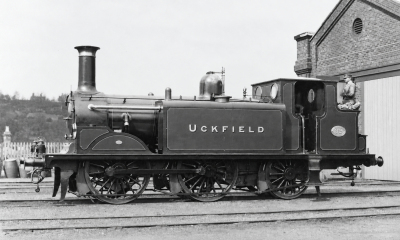
D1 Class Locomotive No. 27 'Uckfield" was completed at Brighton Works between March and June 1876.
As new the locomotive was fitted with the new Westinghouse air brake system, but retained wooden brake shoes as fitted to those of earlier batches. Alterations over the next few years included the change to iron brake shoes and the addition of additional
sanding gear. When new No. 27 'Uckfield' was stationed at Brighton running shed.
In April 1886 No. 27 'Uckfield' left Brighton Works fitted with Tarbutt's oil-burning equipment. Trials under the maker's supervision commenced from Battersea. Although
the system was marginally cheaper to operate than with coal there were adverse comments relating to the output of evil smelling oily smoke when stationary or starting from cold. Also sulphur
and other impurities in the fuel occasionally lowered the steaming rate below that required for mainline use,, while crews complained that the fumes invading the cab when working hard acted as a completely unnecessary laxative! The locomotive was returned to coal burning in October 1886.
Next came a boiler replacement in December 1903. This was of steel construction in three rings, with the dome and spring safety valves on the rearmost. The
condensing gear was retained. The Stroudley Improved Engine Green lasted till approximately 1905 when locomotives of the Class started to be outshopped in Marsh's Umber livery.
No. 27 'Uckfield' was renumbered No. 627 in August 1908 and was promptly motor-train fitted for the Epsom Down - West Croydon motor trains, temporarily sporting large L & B characters on its side tanks. As of December 1922, the locomotive was allocated to Brighton.
With the formation of the new Southern Railway (SR), the locomotive saw a repaint into SR passenger green with the locomotive becoming No. B627. Vacuum ejectors became standard equipment and the feed pumps and condensing equipment removed. Under the 1931 renumbering scheme the B prefix was discarded, and the locomotive was renumbered No. 2627. As of October 1937 the locomotive was shedded at Yeovil for Town - Junction trains but did not stay long as it is recorded as being at Horsham in February 1939. November 1940 saw a repaint into Maunsell unlined light green.
No. 2627 was one of the locomotives, now classed 2P, that was loaned to the London, Midland & Scottish Railway during World War II, heading north in March 1941 to the Beith branch in Scotland. No. 2627's working life finally came to an end in November 1943, being condemned with a defective firebox at Kilmarnock - a life of 67 years.
|